Description
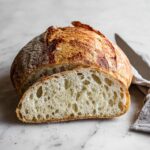
This classic sourdough bread recipe guides you through making a naturally fermented, crusty loaf with a light and airy crumb. Using an active sourdough starter, bread flour, water, and sea salt, the dough undergoes a series of stretch and folds, long bulk fermentation, and cold proofing for enhanced flavor and texture. Baked in a Dutch oven for optimal crust development, this artisan bread is perfect for sandwiches, toasts, or enjoying on its own.
Ingredients
Scale
Sourdough Starter
- 50 to 100 grams ripe bubbly active starter (¼ cup to ½ cup; I use 100 grams)
Wet Ingredients
- 350 to 375 grams warm water (I use 375 grams, less in humid summer months)
Dry Ingredients
- 500 grams bread flour (or all-purpose flour – approx. 4 cups plus 2 tbsp; I prefer organic King Arthur Bread Flour)
- 10 to 12 grams fine sea salt (I use pink Himalayan sea salt)
Instructions
- Feed Your Starter: The day you plan to make the dough, feed your sourdough starter. If it has been refrigerated, take it out the night before and feed it. Feed it again the morning of or a few hours before making your dough. Your starter is ready when it has doubled in size and starts to recede.
- Make The Dough: In a large mixing bowl, combine the active sourdough starter with warm water and salt. Mix with a spoon until well blended. Add the bread flour and mix until a wet, sticky dough forms and all ingredients are incorporated. Cover with a damp kitchen towel and let rest for 30 minutes at room temperature.
- Stretches and Folds: After resting, use a wet hand to gently pull a corner of the dough near the bowl’s edge and fold it into the center. Rotate the bowl and repeat 4-5 times until the dough starts to form a ball. Let rest covered for 30 minutes. Repeat this process three more times every 30 minutes for a total of 2 hours of folding and resting, or do it twice if short on time.
- Bulk Fermentation (Rest): Cover the dough with a damp towel and a lid or plate to prevent drying. Let it rise for 6 to 7 hours at room temperature, or up to 8 to 9 hours in cooler conditions. The dough is ready when it has increased by 50% to 70% in volume, jiggles when shaken, and has visible bubbles on the surface.
- Pre-shape: Turn the dough onto a lightly floured surface. Gently fold the top down to the center while rotating to form a round shape. Use a bench scraper if available to tuck edges under and create surface tension.
- Bench Rest: Flip the dough ball so the smooth side is up. Let it rest for 30 minutes. Then, gently pull the dough toward you to tighten its surface tension, rotating and repeating until you achieve a tight ball shape.
- Shaping and Proof Basket Preparation: Dust a proofing basket generously with flour, or line a medium mixing bowl (~8 inches across) with a floured towel or sprayed and floured surface. Repeat the folding motion as in pre-shaping to form a round loaf. Place the dough smooth side down into the basket or bowl and cover with a shower cap, plastic wrap, or towel.
- Cold Fermentation (Second Rise): Refrigerate the dough overnight, or for 18 to 24 hours. For same-day baking, allow the dough to rest 1 to 2 hours at room temperature until puffy.
- Preheat Oven and Prepare Dutch Oven: Preheat your oven to 450°F (232°C). Cut a piece of parchment paper to fit your Dutch oven.
- Transfer Dough to Parchment: Gently turn the dough out onto the parchment paper. To do this easily, place the parchment on a plate and invert the basket or bowl over it, then flip both together.
- Score the Dough: Using a razor blade, lame, or sharp serrated knife, score the top of the dough in your preferred design (a simple “X” is classic). This allows the bread to expand while baking.
- Bake Covered: Carefully transfer the dough with parchment paper into the preheated Dutch oven. Cover with the lid and place in the oven’s center rack. Bake at 450°F for 30 minutes.
- Bake Uncovered: Remove the lid, reduce oven temperature to 400°F (204°C), and bake for another 20 to 30 minutes uncovered until the crust is deeply browned and the bread sounds hollow when tapped or reaches an internal temperature of 205–210°F (96–99°C).
- Cool: Remove the bread from the Dutch oven and transfer it to a wire rack. Let it cool completely for at least 1 hour before slicing to allow the crumb to set.
Notes
- The amount of water can be adjusted slightly based on the humidity and flour type; stickier dough results in airier bread.
- Multiple stretch and folds strengthen dough structure and gluten development without kneading.
- Cold fermentation overnight improves flavor depth and results in a lighter crumb.
- Use a Dutch oven to mimic a steam environment essential for crust development.
- Allowing the bread to cool completely before slicing prevents a gummy texture.